


Most roofing companies running AccuLynx already know what it does well. It tracks leads, manages a pipeline, and stores job records. But a growing number of operators across storm restoration markets in Kansas, Colorado, Texas, Florida, and the Midwest are finding that activity tracking is no longer enough. The search for a real AccuLynx alternative usually starts the same way: the back office is still reconciling numbers in spreadsheets, project managers are toggling between disconnected tools, and nobody can answer a simple question about real-time margin on a live job.
That gap between tracking activity and controlling revenue is where the roofing industry’s software problem actually lives. This article breaks down what to look for in a replacement, how the leading platforms compare, and what one national roofing operation discovered after making the full switch.
Why Roofing Companies Are Looking for AccuLynx Alternatives
AccuLynx is a CRM built for contact and job management. It handles those functions adequately, but the platform was designed during an era when tracking activity was the primary goal of roofing software. The industry has moved past that.
According to a 2024 report from the National Roofing Contractors Association (NRCA), the average roofing company uses between four and seven disconnected software tools to manage daily operations. Each gap between those tools creates a place where data drifts, leads stall, or money disappears without a clear audit trail.
In our experience working with roofing operators, the breaking point usually shows up in one of three places. First, commission disputes caused by manual spreadsheet tracking. Second, delayed financial visibility because the CRM and the accounting system do not talk to each other natively. Third, materials ordering that happens outside the CRM entirely, which means estimate-to-order data is disconnected from job cost tracking.
AccuLynx was not built to solve those problems. It was built to manage contacts and pipeline stages. That distinction matters when the real cost of your software is not the subscription fee but the revenue leaking through the gaps between your tools.
What a Real AccuLynx Replacement Needs to Deliver
A genuine AccuLynx alternative needs to do more than replicate its CRM features in a different interface. It needs to close the operational gaps that AccuLynx was never designed to address. Here are the six capabilities that separate a true replacement from a lateral move.
Real-Time Revenue Visibility
You should be able to see live margin, pipeline value, and cash position at any moment. Not after someone exports data and builds a report. Not at the end of the month. Right now, on any job, across every market your company operates in.
Native Accounting Integration
QuickBooks connectivity should exist at the system level, not through a third-party connector that drifts out of sync. When the operations team and the accounting team see different numbers, the problem is not the people. It is the software architecture.
End-to-End Pipeline Control
The full lifecycle from lead capture through job close through cash collection should operate in a single continuous workflow. Every handoff between disconnected systems is a point where leads stall or data gets lost.
Commission and Margin Automation
Commissions should calculate automatically based on actual job data. Margin tracking should update continuously as job costs change. According to Remodeling Magazine’s 2025 Cost vs. Value Report, labor and material cost volatility in roofing increased by over 12% year over year, making static commission calculations increasingly unreliable.
Materials and Measurement Ordering
Ordering from suppliers like Beacon (now QXO) and measurement providers like RoofScope or EagleView should happen inside the platform. If your estimator has to leave the CRM to place a materials order, you have a workflow gap that adds time and introduces errors.
Fast Deployment
A platform that takes three to six months to deploy is not built for roofing operators. It is built for enterprise IT departments. A real replacement should get your entire team operational in weeks, not quarters.
How Trussi.ai Compares to AccuLynx
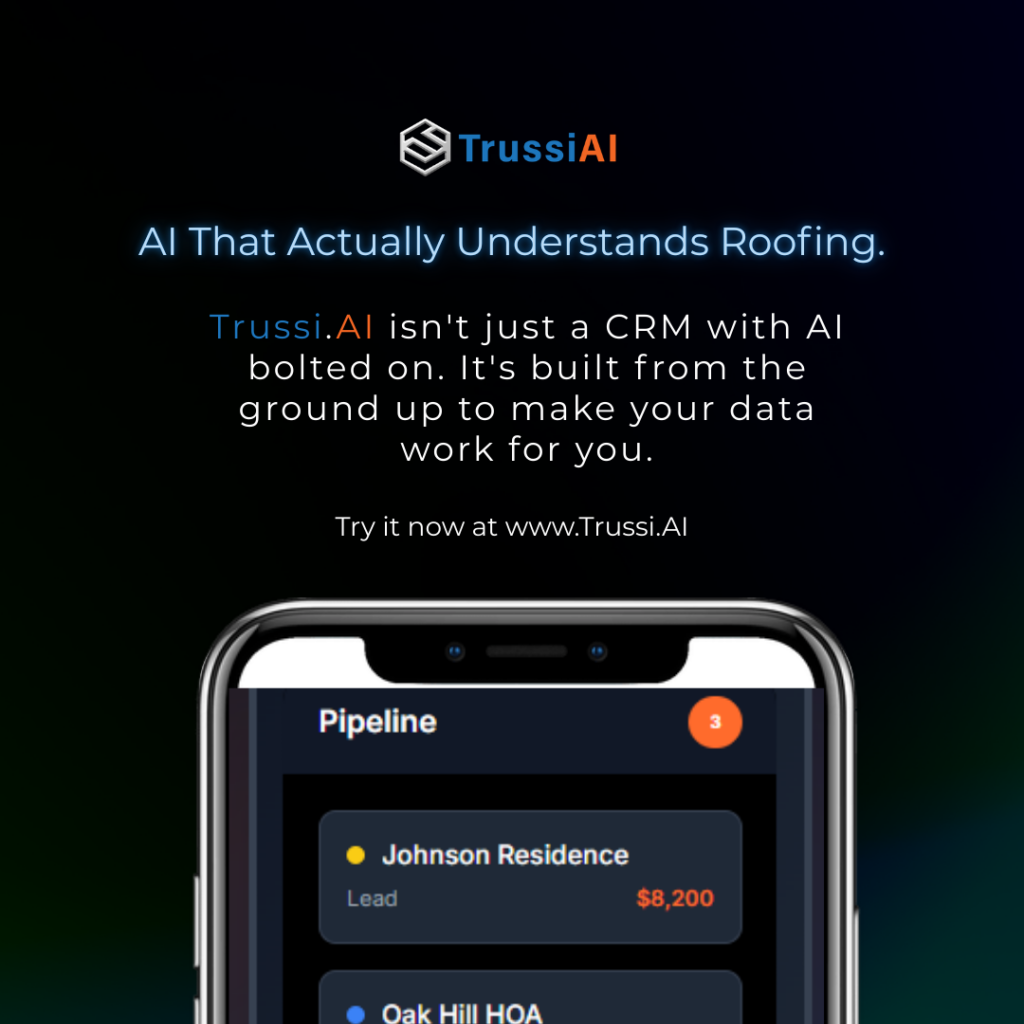
Trussi.ai was built by a roofing operator who spent years running a national storm restoration company on AccuLynx before deciding the industry needed something fundamentally different. The platform is not a CRM with add-ons. Trussi calls it a Revenue Operating System: a single platform that manages the complete workflow from lead acquisition through final collection, with financial visibility built into every layer.
| Capability | AccuLynx | Trussi.ai |
|---|---|---|
| CRM and pipeline management | Yes | Yes |
| Real-time revenue visibility | No | Yes |
| Native QuickBooks integration | Limited / third-party | System-level sync |
| Commission automation | No | Automatic from job data |
| Continuous margin tracking | No | Real-time per job |
| Materials ordering (Beacon/QXO) | Not embedded | Built-in, one-click |
| Measurement ordering (RoofScope, EagleView) | Not embedded | Built-in |
| AI-powered lead scoring | Basic | Patent-protected, multi-attribute scoring |
| Voice AI agents | No | On roadmap (inbound and outbound) |
| Full deployment time | Weeks to months | 17 days |
| Pricing (per user/month) | Enterprise pricing, ~$50K+/mo at scale | Starts at $0 (free tier), Pro at $99/user/mo |
The pricing difference deserves attention. AccuLynx uses enterprise-level per-user pricing that can reach $50,000 or more per month for large operations. Trussi.ai offers a free Starter tier, a Pro tier at $99 per user per month, and a Growth tier at $79 per user per month for teams of three or more. A 14-day free trial of Pro-tier features is available with no credit card required.
The Shamrock Deployment: Full AccuLynx Replacement at Scale
Shamrock Roofing, a national storm restoration operation, completed a full displacement of AccuLynx in early 2026 and migrated entirely to Trussi.ai. This was not a pilot program or a partial rollout. It was a complete system replacement.
The verified deployment numbers tell the story. Shamrock transitioned 176 project managers to Trussi. AccuLynx was fully removed from operations. QuickBooks Online was integrated and running. The platform processed over 1,090 leads per month through a unified pipeline. The entire system was operational within 30 days.
Shamrock operates across multiple markets including Kansas City, Wichita, Denver, and other storm-active regions. The deployment had to work for field teams in different markets with different weather patterns, different material costs, and different crew structures. That kind of multi-market complexity is exactly where disconnected tool stacks break down and where a unified Revenue Operating System proves its value.
What makes Shamrock’s experience especially relevant for other roofing companies is the scale. If a platform works for an operation managing 176 PMs and processing a thousand leads a month across multiple states, it can handle a 10-person team running a single market.
What Makes Trussi.ai Different From Other Roofing CRMs
The roofing software market has several players, and anyone evaluating an AccuLynx alternative will likely also look at JobNimbus, ServiceTitan, and Roofr. Here is how Trussi.ai is positioned differently from each.
Trussi vs. JobNimbus
JobNimbus offers solid CRM functionality at a more accessible price point than AccuLynx. However, it relies heavily on third-party integrations to approximate a complete system. At scale, those integrations break, data drifts, and operators lose the financial visibility they need. Trussi.ai eliminates the integration layer entirely by building materials ordering, measurements, accounting, and reporting into a single native platform.
Trussi vs. ServiceTitan
ServiceTitan is a powerful platform, but it was built for the broader home services market, not specifically for roofing. ServiceTitan deployments typically require three to six months of onboarding and dedicated training teams. Trussi.ai deploys in 17 days and is built from the ground up for roofing-specific workflows including storm restoration, insurance claims, and aerial measurement ordering.
Trussi vs. Roofr
Roofr focuses primarily on measurements and proposals. It is a useful point solution, but it does not provide the end-to-end operational control that a full AccuLynx replacement requires. Trussi.ai covers the complete lifecycle from lead through close through cash collection.
Trussi.ai’s Patent-Protected Lead Scoring
One capability that no other roofing CRM can replicate is Trussi’s lead scoring engine. Trussi holds U.S. Patent 12,131,277 B2 (granted October 2024) covering a system that divides geographic regions into subregions based on weather event intensity, calculates lead scores using weighted financial, demographic, and property-based attributes, and autonomously acts once scoring thresholds are met.
This is not a rules-based automation where a human sets triggers. It is a closed-loop predictive system that scores leads and takes action without manual intervention. According to the patent filing, the system can automatically order materials, schedule workers, and launch campaigns based on probabilistic lead scoring. No competitor in the roofing CRM space holds equivalent intellectual property.
For storm restoration contractors working hail corridors across Texas, Colorado, Kansas, and the Southeast, this kind of automated lead qualification becomes a force multiplier during high-volume storm seasons when speed to lead determines who wins the job.
Frequently Asked Questions About AccuLynx Alternatives
How much does it cost to switch from AccuLynx to Trussi.ai?
Trussi.ai offers a free Starter tier and a 14-day free trial of Pro features with no credit card required. Pro pricing starts at $99 per user per month. Growth pricing for teams of three or more is $79 per user per month. Data migration from AccuLynx is included in the onboarding process, and there are no setup fees.
How long does it take to deploy Trussi and fully replace AccuLynx?
Full deployment including data migration, workflow configuration, and team onboarding completes in 17 days. Shamrock Roofing transitioned 176 project managers and was fully operational within 30 days. This is a complete system replacement, not a phased rollout that runs in parallel for months.
Does Trussi integrate with QuickBooks?
Yes. Trussi.ai integrates with QuickBooks Online at the system level, not through a third-party middleware connector. Invoice sync, payment recording, and financial reporting stay synchronized automatically. This eliminates the manual reconciliation that most roofing companies deal with when their CRM and accounting system are disconnected.
Can I order materials and measurements inside Trussi?
Yes. Trussi.ai has built-in ordering for roofing materials through Beacon (QXO) and roof measurements through RoofScope, with EagleView integration planned. Contractors can go from estimate to materials order without leaving the platform, and all costs flow directly into job-level financial tracking.
Is Trussi.ai built specifically for roofing companies?
Yes. Trussi.ai was built by a roofing operator for roofing operators. The platform supports roofing-specific workflows including storm restoration, insurance supplement tracking, aerial measurement ordering, and crew scheduling across multiple markets. It is not a general contractor CRM adapted for roofing.
How do I choose the right AccuLynx alternative for my roofing company?
Focus on three things. First, can the platform show you real-time margin on every job without manual reporting? Second, does it connect your operations and accounting natively, or through middleware that can drift? Third, how fast can you actually deploy and get your team productive? Any platform that cannot answer those three questions clearly is selling you a lateral move, not an upgrade.
See What Your Current Stack Is Costing You
Trussi.ai was built for roofing companies that have outgrown their CRM but refuse to spend six months onboarding an enterprise platform that was not built for their industry. The Revenue Leak Assessment on the Trussi.ai website takes a few minutes, quantifies where your current AccuLynx setup is losing money, and generates a personalized teardown briefing with specific numbers.
You can also book a 17-minute teardown call where the Trussi team walks through your current stack, identifies the gaps, and shows exactly how the Revenue Operating System closes them. No obligation. No six-month sales cycle. Just the numbers.
Visit trussi.ai to take the free Revenue Leak Assessment or book your teardown call today.